What Keeps Online STEM Students Enrolled | Labster Research
New research surveyed 400+ online and hybrid STEM students to reveal what drives persistence and retention, and why experiential learning is the key.

Name of the heading
Dana runs the grants office at a regional public university where more than half of STEM enrollments are now online or hybrid. Her provost wants virtual labs in every gateway biology and chemistry section by next fall. The budget office has one question: who's paying for it?
Dana has a folder of funding options, and her own questions:
The short answer is that several federal programs can pay for virtual labs, as long as the purchase is tied to the outcomes the program exists to improve. Below, we cover where virtual labs fit in a grant narrative, the federal sources worth checking, how the picture differs for online and hybrid institutions, and what makes an application stronger.
Federal reviewers don't score technology purchases. They score plans to move a measurable outcome, and the technology is one line in the budget that makes the plan possible.
A proposal that asks for "a virtual lab license" reads as a shopping list. A proposal that asks for support to close the completion gap between online and in-person sections of gateway science courses reads as a project, with virtual labs as the method.
The good news for online and hybrid institutions is that virtual labs connect to the outcomes most federal programs already track:
Start with the outcome your institution needs to improve. Then show how virtual labs help you get there. For more proof points to build your case around, explore Labster's research library, which includes peer-reviewed studies and institutional case studies.
Federal higher education funding shifted significantly in 2026. Under a new interagency partnership, the U.S. Department of Labor (DOL) took on a larger role in administering programs from the U.S. Department of Education (ED). Some competitions were consolidated, and new priorities emerged around workforce readiness and AI. The 2026 cycle is the best available guide to what reviewers will look for next.
It also showed how little time applicants may get. The FY 2026 Strengthening Institutions Program notice posted May 21 and closed June 23. Institutions that have their baseline data, narrative, and partners ready before a notice posts will be in the strongest position.
Here are federal funding mechanisms you can consider for virtual labs. For each one, we cover what it funds, what changed in 2026 where relevant, and what to prepare for in 2027. Not every program will fit every institution, so start with the ones that match your eligibility and goals.
For many institutions, the Strengthening Institutions Program (SIP) is the strongest fit. Its authorized activities include purchasing or leasing laboratory equipment, developing academic programs, and building distance education capacity. ED's list of example projects includes converting high-demand STEM courses to online or hybrid delivery. To apply, an institution must first be designated eligible, generally based on its share of students receiving need-based aid or Pell Grants and low educational and general expenditures.
In 2026: DOL ran an unusually large competition on ED's behalf, with an estimated $365.9 million available and individual grants up to $3 million over five years. Priorities emphasized workforce readiness, AI, and short-term programs, and the agencies described the funding level as a one-time investment.
For 2027: ED usually runs SIP competitions in odd-numbered years and funds down the previous slate in even years. 2026 broke that pattern, so it isn't yet clear whether FY 2027 brings a new competition. Confirm your eligibility designation, which runs as a separate process earlier in the year, and keep a retention-focused narrative ready to adapt.
In 2026: ED did not hold competitions for Developing Hispanic-Serving Institutions (DHSI) and several other Minority-Serving Institution (MSI) programs. It moved those funds into SIP.
For 2027: If your institution has relied on these programs, plan around SIP eligibility and track FY 2027 appropriations for any change.
FIPSE funds projects that improve postsecondary outcomes, and it announces competitions year by year.
In 2026: The Postsecondary Student Success Grants (PSSG) program funded evidence-based strategies to improve retention and completion, with awards up to $4 million for early-phase projects and $8 million for mid-phase projects. Appropriations also funded other FIPSE programs, including the $45 million Rural Postsecondary and Economic Development program.
For 2027: PSSG tied funding to evidence tiers. A pilot in one gateway course during spring 2027, with outcomes tracked, can give you the rationale and early evidence a future application needs.
NSF funds projects that improve STEM teaching and learning and study what works, rather than purchases on their own. A proposal that integrates virtual labs into a gateway course and measures the effect on persistence fits that model.
For 2027: Several NSF deadlines are still ahead, so this is the most predictable path for near-term planning:
NSF proposals are usually led by faculty, so pair your grants office with a STEM department chair now.
Perkins V formula funds flow through states to colleges for career and technical education (CTE) programs, which can include allied health and biotechnology pathways. Spending must align with your comprehensive local needs assessment.
For 2027: The outlook is uncertain. The administration has proposed eliminating federal support for postsecondary CTE under Perkins V and moving its administration to DOL. Check with your state CTE office before planning.
The same virtual labs can support different grant narratives depending on how your students learn.
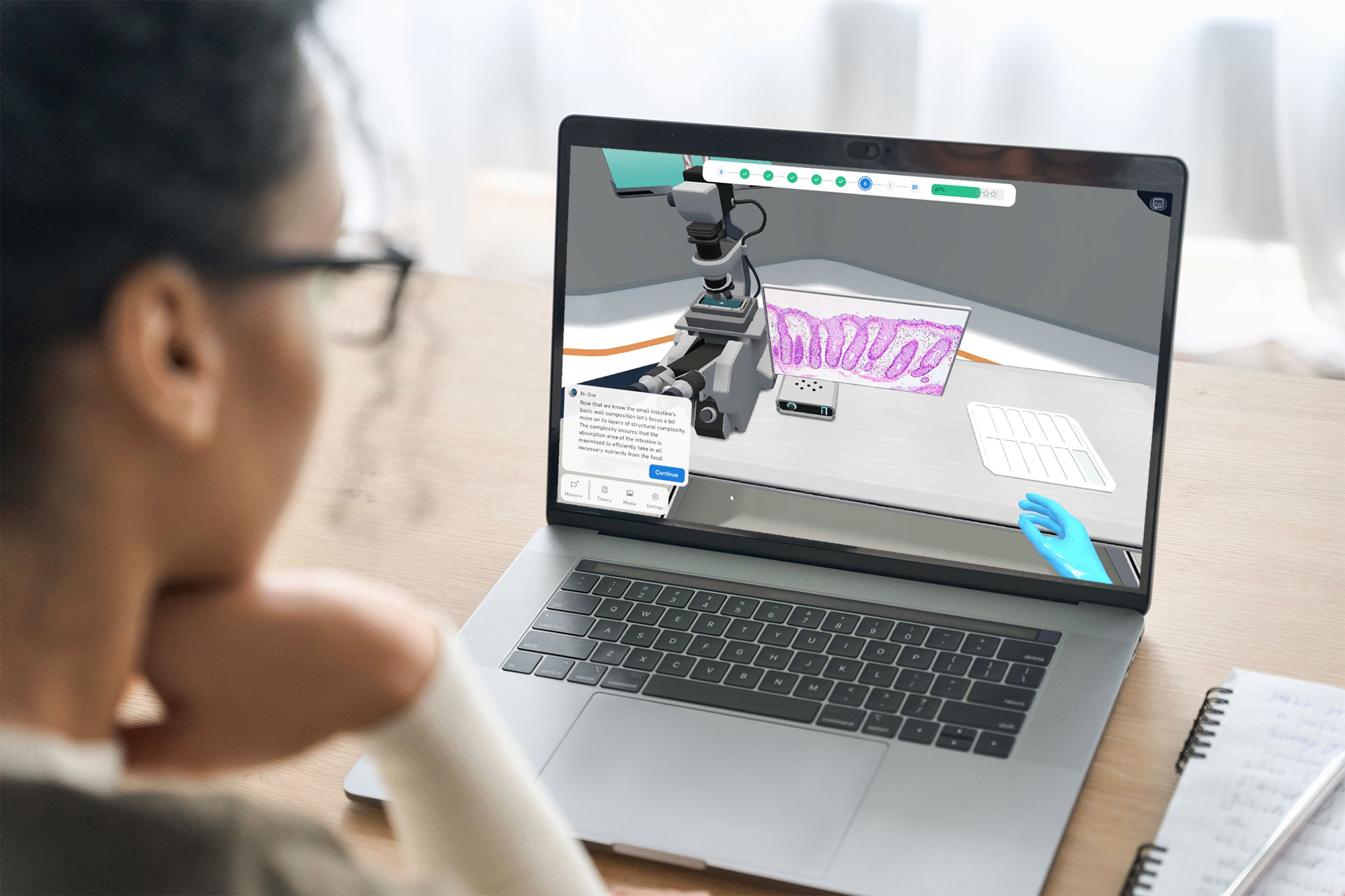
For fully online programs, the case is usually about access and parity. Your students can't come to a campus lab, so reviewers will question how they get hands-on experiences. Virtual labs fill that gap, and they map to SIP's distance education activities and FIPSE's focus on completion.
Lead with the gap you're closing. If online sections of a gateway course complete or pass at lower rates than in-person sections, that comparison is your problem statement. It's also something students notice before they enroll: in Labster's research, 81% of online and hybrid STEM students said access to virtual labs would have positively influenced their decision to enroll in a specific program.
For hybrid programs, the case is usually about readiness and capacity. Students still complete in-person labs, but they often arrive without the preparation to use that time well. Virtual pre-labs let students practice procedures before they step into the physical lab, so faculty can spend lab sessions on higher-order work.
That framing fits SIP's academic program and lab activities, NSF's focus on engaged student learning, and, for allied health and technician pathways, Perkins V.
Back in Dana's office, the funding question looks different. She isn't searching for a grant that buys software. She's building a case that her institution can close a completion gap in gateway science courses, with a clear method, a defensible budget, and a plan to measure results. Virtual labs are part of that method.
Federal priorities will keep shifting, and program rules change from one cycle to the next. Always confirm current eligibility and allowable costs with the program officer before you submit. The fundamentals stay steady: reviewers fund outcomes, and virtual labs give online and hybrid programs a practical way to improve them.
Planning a proposal? Talk with our team about payment options, implementation plans, outcome data, and pricing that fits your grant budget.
Explore how Labster pricing works for your institution and get a quote based on your program's size and needs. Annual plans start at $5,000 USD.