What Keeps Online STEM Students Enrolled | Labster Research
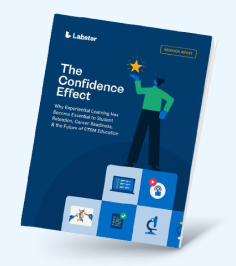
New research surveyed 400+ online and hybrid STEM students to reveal what drives persistence and retention, and why experiential learning is the key.



Name of the heading
Have you ever had a student who rushed into a lab activity without putting on their safety goggles? Or one who, despite your careful instructions, grabbed a hot beaker with bare hands? These moments are stressful. A single oversight can lead to a dangerous incident or rattle a student’s confidence (and your peace of mind as the instructor) for the rest of the semester.
But what if your learners could make those mistakes in a space where no one gets hurt and nothing gets broken?
In immersive virtual labs, students can’t injure themselves or others, and there’s no risk of damaging costly equipment. Instead, they’re free to explore, experiment, and learn from missteps—all within a safe, controlled setting. And the impact is real. Educators report that virtual lab safety training helps reinforce habits that stick.
“The simulations are really useful because, in the virtual lab, it always reminds the students to wear a lab coat and then get a pair of gloves and goggles. Labster is very, very helpful in preparing them to be safe.” — Dr. Stephani Joy Macalino, Associate Professor, De La Salle University.
At Labster, we hear this kind of feedback time and time again: virtual labs don’t just teach science—they build safer, more prepared students. Let’s explore how.
With packed syllabi and limited class and lab time, safety training is often front-loaded in the first week. Resource limitations compound the issue with some labs lacking critical equipment like a functioning fume hood or enough eye goggles for every student. Add large class sizes to the mix, and it becomes nearly impossible for instructors to monitor every student’s actions, especially when TAs may not feel confident enforcing safety protocols. These barriers make it clear that while the educator’s commitment to safety is strong, the reality of the system can make it difficult to uphold. This is where virtual labs can be a huge help.
When used as a pre-lab, virtual labs prepare students to enter the physical lab with both the knowledge and mindset needed to avoid risky mistakes. Labster’s retention study found that students who complete a simulation beforehand are five times more likely to say they plan to stick with STEM—a sign of increased confidence and competence.
Labster turns common safety oversights into teachable moments. Whether students forget their goggles and get acid in their eyes (this really happens in Labster) or accidentally set the lab on fire (yup, this too), they can safely explore the consequences of this very unsafe behavior and immediately correct it so it never happens in wet labs.
Because students can revisit simulations as often as they need, they’re not just checking off a safety box; they’re building long-term habits. By reinforcing the basics through repetition and interaction, Labster helps students develop the instincts and behaviors that lead to safer, smoother lab sessions all semester long.
Labster has multiple lab safety simulations available for instructors to use to help students get a great safety foundation:
Virtual labs don’t replace physical labs—they make them better.
At a time when educators are stretched thin and student preparedness varies widely, Labster acts as an extension of your teaching toolkit, one that reinforces safety through immersive, repeatable learning experiences. Whether you’re teaching biology, chemistry, microbiology, or beyond, there’s a simulation that fits your course and sets your students up for safe, successful lab sessions.
The safest labs are the ones where students are prepared before they even step inside.
Labster helps make that possible.
Explore how Labster pricing works for your institution and get a quote based on your program's size and needs.